← Back to journal
MOVE7 min read2026-04-07
Why your training and your rehab should never be in separate boxes
Most people train with one person and rehab with another, and neither knows what the other prescribed. That gap is where injuries happen. One coach who understands both closes it.
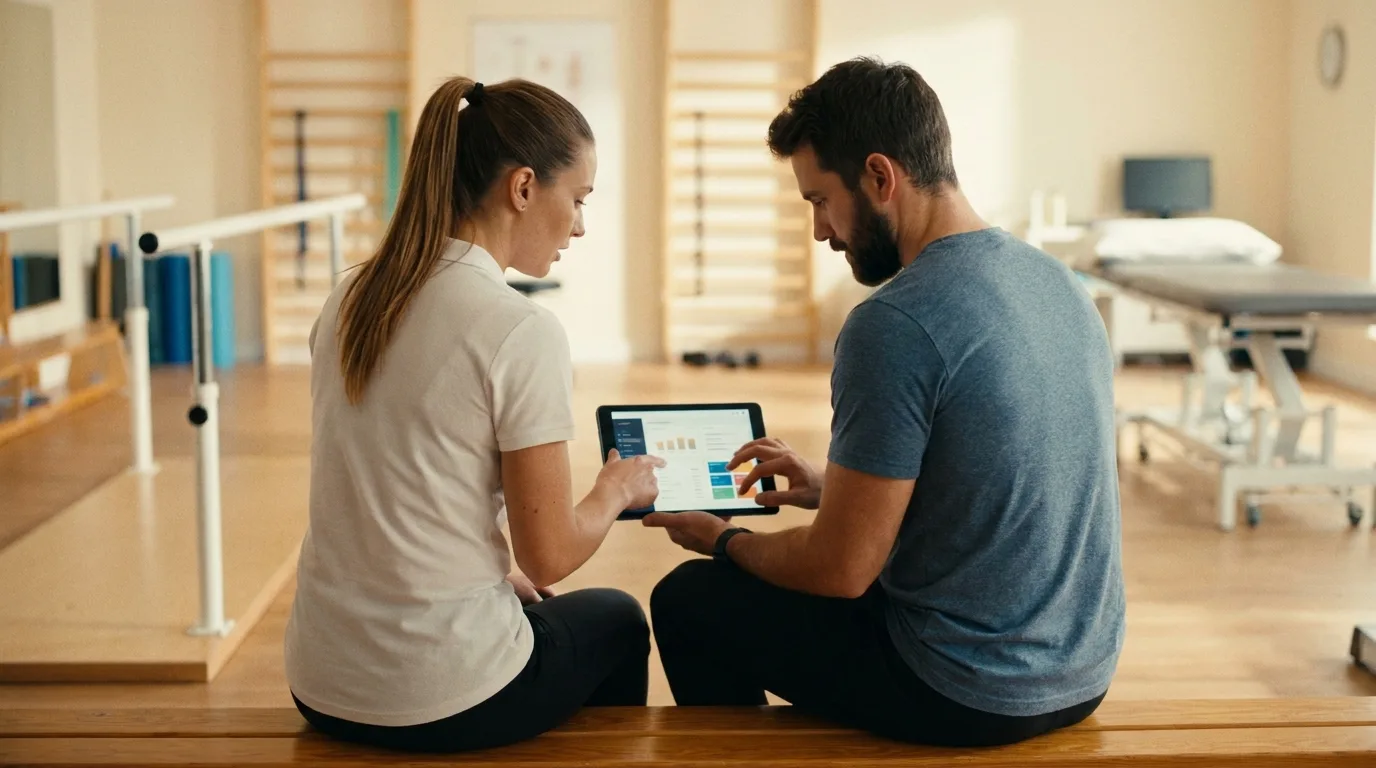
Most people treat training and rehabilitation as two separate worlds. You exercise with a personal trainer, you rehab a niggle with a physiotherapist, and the two never speak. Neither knows what the other has prescribed.
That gap is not just inefficient. It is where injuries happen.
The simplest fix is also the most overlooked: one coach who understands both how to build strength and how rehabilitation principles work, who sees your whole picture, and who can coordinate with any specialist you already see rather than working in isolation. That is the model Sway is built on.
Key takeaways
1. When the person training you does not know what your physio found, you often end up with conflicting advice and avoidable injuries.
2. Coordinated, joined-up care produces better outcomes for back pain than care delivered in silos.
3. The answer is not a committee. It is one qualified coach who understands both training and rehab, and who talks to the physio or GP you already see.
The problem with the silo
A trainer programmes heavy squats because they do not know a physio flagged a hip impingement last week. The physio prescribes gentle mobility work, not knowing the trainer already has you doing loaded stretches three times a week. You are the only person who knows both halves of the story, and you are not the expert.
A 2015 Cochrane review found that multidisciplinary rehabilitation produced significantly better outcomes for chronic low back pain than single-practitioner care, with greater improvements in pain and function across 41 trials (Kamper et al., 2015). The lesson is not that you need a dozen practitioners. It is that the parts of your care have to be connected.
Left to chance, they rarely are. Most people carry information between professionals who never meet, paraphrasing a diagnosis they only half understood.
What changes when one person sees the whole picture
When the person writing your programme knows your physio cleared you for loaded hip flexion but flagged restricted left ankle dorsiflexion, everything downstream changes. The squat variation changes. The rep range changes. The warm-up changes. Nothing is wasted, because nothing is happening blind.
A long-term follow-up study found that patients who received coordinated physiotherapy and exercise prescription had significantly lower recurrence of low back pain over three years (Hides et al., 2001). Continuity is the active ingredient.
As Sway's head coach puts it: a physio can assess a problem in 45 minutes, but if the person training you three times a week does not know what was found, the assessment is wasted.
How Sway approaches this
Sway gives you one dedicated coach, qualified in both Pilates and Strength and Conditioning, who works with you in your home across London or live online wherever you are. Because that same coach builds your programme, watches you move every week, and adjusts as you progress, there is no information lost in the handover. There is no handover.
If you already see a physiotherapist or GP, your coach coordinates with them directly rather than ignoring them. If something falls outside a coach's remit, Sway can introduce you to trusted independent specialists in recovery, nutrition or mental wellbeing through a vetted referral network. These are not Sway staff. They are good people your coach knows and trusts, brought in only when you actually need them.
This is not complicated. It just requires that the person guiding your body actually knows what is happening to it. Most of the health system does not work that way.
What you can do today
Ask whoever currently trains you one question: do you know what my physio found, and have the two of you spoken?
If the answer is no, that is the gap where problems happen. You should not be the one carrying information between them. The point of working with one coach who understands both training and rehab is that you never have to.
If you would like a clear, unhurried look at how you move, Sway offers a free initial assessment, online or in your home in London. No pressure, no hard sell.
Ready to stop guessing?
Book your assessment and meet your coach