← Back to journal
LIFE6 min read2026-04-22
In-home personal training in London: what actually happens
No gym, no commute, no audience. Here is what an in-home personal trainer in London actually does, from the first knock at the door to the work that fills the rest of your week.
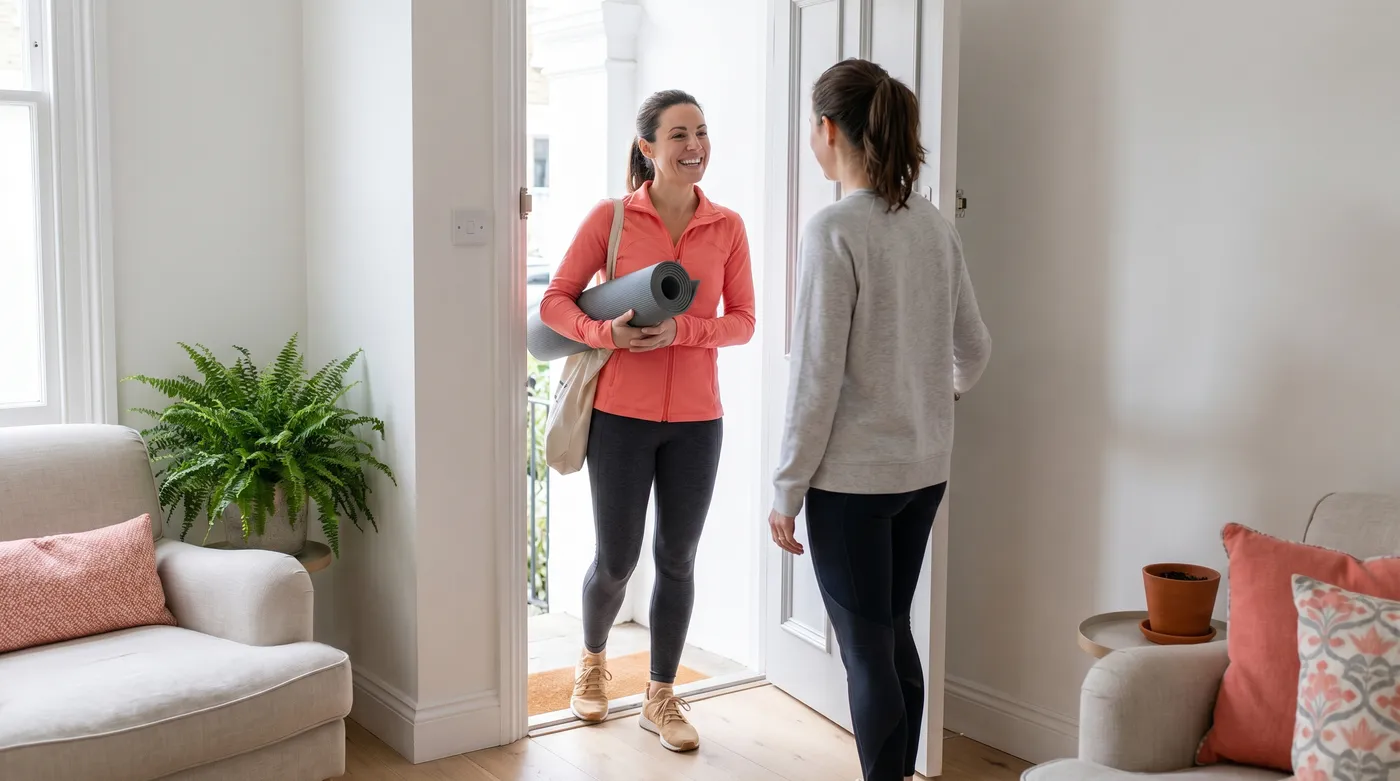
An in-home personal trainer comes to your house, assesses how you move, and coaches your sessions in your own living room rather than at a gym. No commute, no membership, no waiting for equipment, and no audience. The trainer brings what is needed, works around your space, and builds the programme around your life rather than a gym timetable.
That is the short version. If you are weighing up an at-home personal trainer in London, here is what the experience actually looks like, week by week, and where it differs from the gym you may be picturing.
Key takeaways
1. In-home personal training means a qualified coach trains you in your own home, using your space and a small amount of portable equipment.
2. It removes the two biggest reasons people stop training: the commute and the self-consciousness of a busy gym.
3. Adherence, doing the sessions consistently, is the single strongest predictor of results, and convenience drives adherence (NHS, 2024).
4. A good in-home coach assesses first, programmes around your real life, and is honest about when to bring in another professional.
The first visit: assessment, not a workout
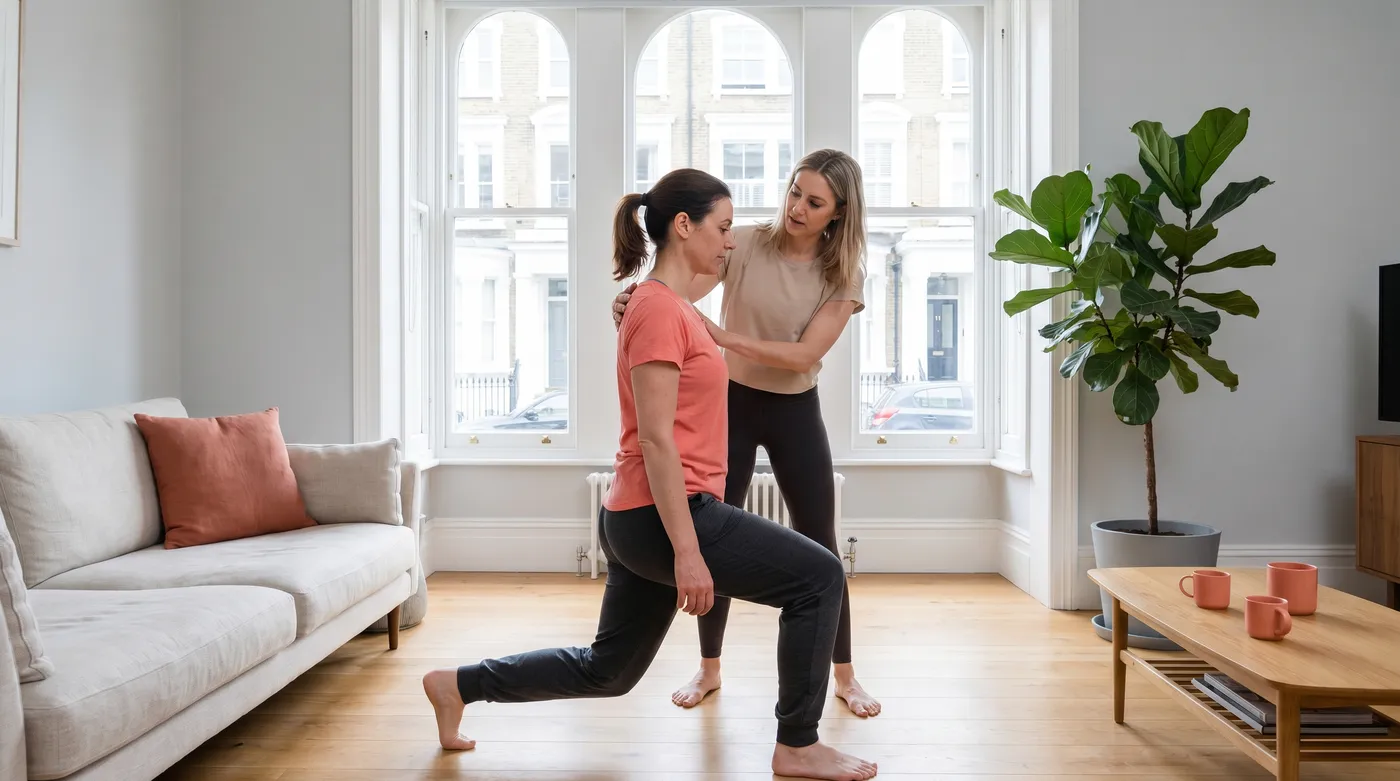
The first session is not a session. It is an assessment. A good coach spends it watching how you move, asking about your history, your goals, any pain or past injury, how you sleep, and what your days actually demand of you.
This matters more at home than at a gym, because your home is the context. The coach can see the stairs you climb every day, the low sofa you struggle out of, the kitchen counter you brace on. None of that is visible in a gym. By the end, the coach should be able to tell you plainly what your body needs, not what you assumed it needed.
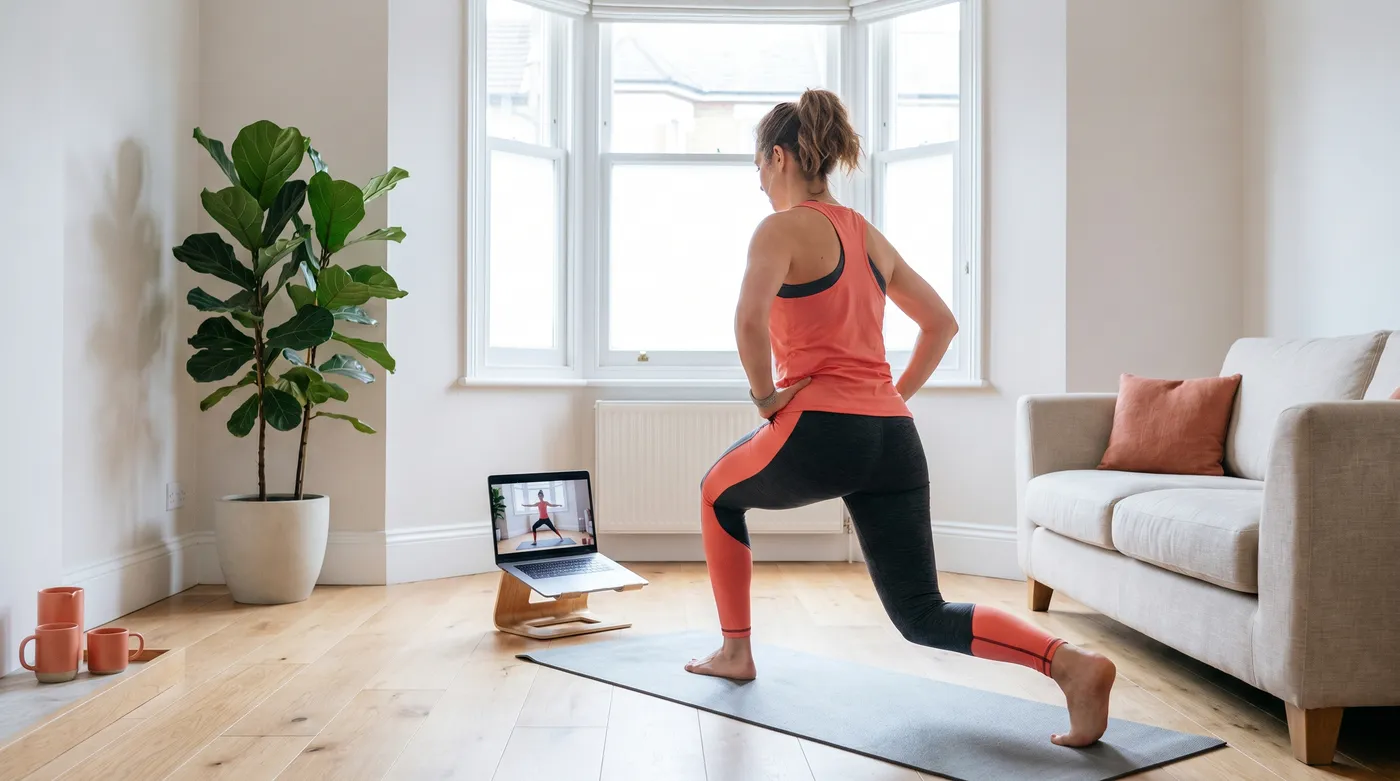
At Sway this is a free 45-minute assessment, in your home across London or live online, whichever you would rather start with.
What the trainer brings, and what your home provides
You do not need a home gym. Most effective training for general strength, mobility and longevity uses very little kit: resistance bands, a set of adjustable dumbbells, a mat, and your own bodyweight. A skilled coach can build a serious programme from a chair, a wall and a doorway.
If you have a reformer, a few weights or a spare room, the coach uses them. If you have a corner of the lounge, that works too. The space adapts to you, which is rather the point.
Why training at home changes the outcome
People assume the gym is where the real work happens. The evidence points more towards consistency than venue. The NHS physical activity guidance is built on the idea that regular, sustainable movement, done in a way that fits your life, is what protects long-term health (NHS, 2024). The best programme is the one you actually keep doing.
Two friction points stop most people. The first is the commute, the half hour each way that quietly turns three planned sessions into one. The second is self-consciousness, particularly for people returning to exercise after years away, after pregnancy, after injury, or later in life. A study of exercise adherence found that perceived convenience and comfort of the environment were strongly associated with sticking to a programme over time (Sperandei et al., Journal of Science and Medicine in Sport, 2016). At home, both frictions disappear. The session comes to you, and the only person watching is your coach.
There is a quieter benefit too. Because the work happens in the place you live, the movements tend to transfer directly. Getting off the floor, carrying shopping in from the car, climbing your own stairs without holding the rail. You practise the things your life asks of you, in the place it asks of you.
What a typical week looks like
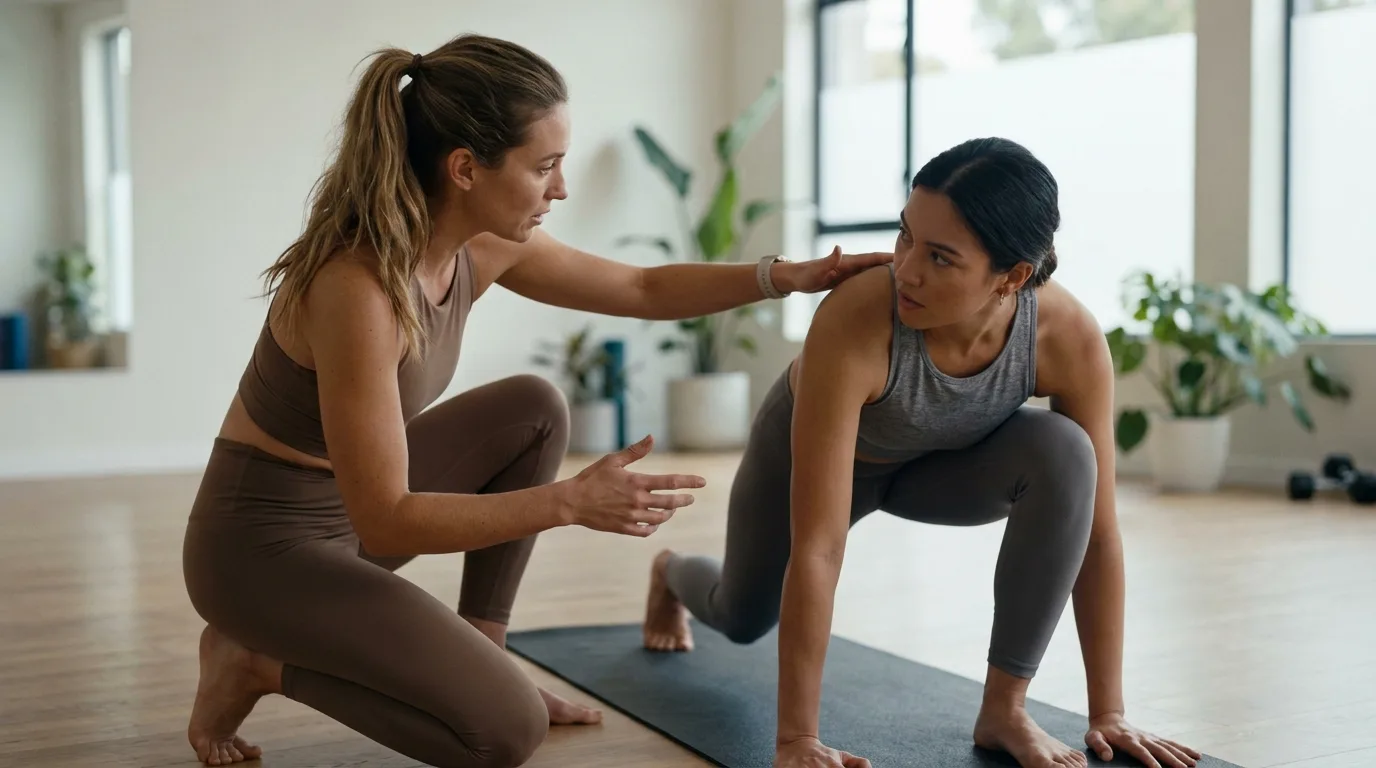
Most people train one to three times a week with their coach, with simple homework in between, a few movements to keep the body ticking over between sessions. The coach watches your technique, adjusts the load as you get stronger, and changes the plan when life gets in the way, because at home, life is right there in the room.
If something starts to niggle, the coach notices early, because they see you every week and know your baseline. That continuity is hard to get when you train alone or rotate through different instructors at a studio.
How Sway approaches this
Sway is in-home and online personal training in London. You work with one dedicated coach, qualified in both Pilates and Strength and Conditioning, who trains you in your own home across London, or live online wherever you are in the world. The same coach assesses you, builds your programme and coaches every session, so nothing is lost in a handover and there is no handover to begin with.
Sway is in-home and online personal training in London, a team of coaches qualified in both Pilates and Strength, with more than 35,000 sessions delivered since 2018. Where you need expertise beyond coaching, in physiotherapy, nutrition, recovery or mental wellbeing, your coach can introduce you to a trusted independent specialist through a vetted referral network. Those specialists are not Sway staff; they are people your coach knows and trusts, brought in only when they would genuinely help, and your coach coordinates with them so the work stays joined up.
What you can do today
Look honestly at why past attempts at training tailed off. For most people it was not the programme. It was the friction: the journey, the timetable, the feeling of being watched.
If that sounds familiar, training at home removes the friction rather than asking you to push through it. Sway offers a free 45-minute assessment, in your home across London or live online. No pressure, no hard sell, just an honest read on what your body needs.
References
NHS. Physical activity guidelines for adults aged 19 to 64. 2024. Full citation
Sperandei S, et al. Adherence to physical activity in an unsupervised setting. Journal of Science and Medicine in Sport. 2016. Full citation
Ready to stop guessing?
Book your assessment and meet your coach