← Back to journal
MOVE7 min read2026-04-23
Exercise for bone density: how to train for stronger bones and osteoporosis
Bone is living tissue that responds to load. The right exercise can slow bone loss and, in some cases, build density back. Here is what the evidence says actually works, and what to avoid.
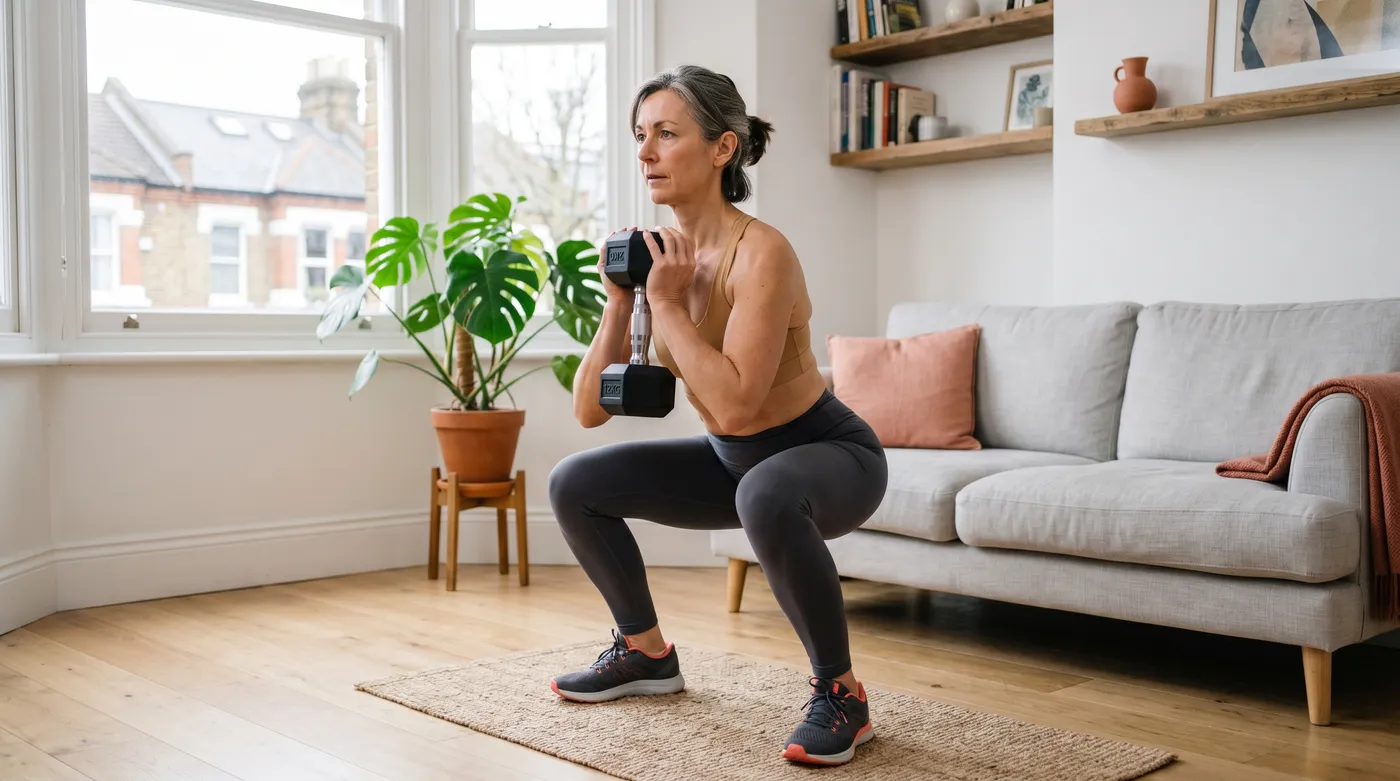
The most effective exercise for bone density is a combination of progressive resistance training and weight-bearing impact, performed regularly. Bone is living tissue: load it sensibly and it adapts by getting stronger and denser. Leave it unloaded and it quietly thins. For people with osteoporosis or low bone mass, the right exercise can slow that loss and, in some cases, rebuild density, while also cutting the risk of the falls that turn thin bone into a broken hip.
That is the headline. The detail matters, because not all exercise loads bone, and some movements need care if your bones are already fragile.
Key takeaways
1. Bone responds to mechanical load. Resistance training and weight-bearing impact are the forms of exercise that build and preserve bone density; swimming and cycling, while excellent for the heart, do little for bone.
2. Supervised high-intensity resistance and impact training improved bone density at the spine and hip in postmenopausal women with low bone mass (Watson et al., 2018).
3. Osteoporosis affects around 1 in 2 women and 1 in 5 men over 50 in the UK (Royal Osteoporosis Society).
4. If you have osteoporosis or a known fracture, get individualised guidance before loading; technique and progression matter, and certain movements need adapting.
Why bone needs load
Bone is not inert scaffolding. It is constantly being broken down and rebuilt, and the signal that tells your body to build it is mechanical stress. When a muscle pulls hard on a bone, or your foot strikes the ground with force, the bone reads that as a demand and lays down more tissue in response. Remove the demand, through bed rest, inactivity, or even spaceflight, and bone is lost quickly.
This is why the type of exercise matters so much. Walking helps a little. Swimming and cycling, for all their cardiovascular value, do almost nothing for bone, because the load is too low and there is no impact. To move the needle on bone density you need either meaningful resistance or impact, ideally both.
The evidence on resistance and impact training
The clearest recent evidence comes from the LIFTMOR trial. A 2018 study in the Journal of Bone and Mineral Research put postmenopausal women with low bone mass through high-intensity resistance and impact training twice a week, supervised, for eight months. The training group improved bone mineral density at the lumbar spine and femoral neck, the two sites where osteoporotic fractures are most dangerous, and did so safely under supervision (Watson et al., JBMR, 2018).
That finding overturned an old assumption that people with thinning bone should avoid lifting anything heavy. Done with good technique and sensible progression, the opposite is true: appropriate load is one of the few things that actually builds bone in later life.
The Royal Osteoporosis Society, the UK's leading authority, recommends a combination of muscle-strengthening exercise and weight-bearing activity with impact for bone health, with the intensity matched to the individual's bone status and fracture risk (Royal Osteoporosis Society).
Falls matter as much as bone
A dense bone that breaks in a fall is still a broken bone. For older adults, preventing the fall is at least as important as strengthening the skeleton, and the two goals share the same training.
A 2019 Cochrane review found that exercise programmes combining strength and balance work reduced the rate of falls in older people living in the community by around a third (Sherrington et al., Cochrane Database, 2019). So the ideal bone programme does double duty: it loads the skeleton and trains the balance and leg strength that keep you upright in the first place.
What to be careful with
If you have diagnosed osteoporosis or a history of fragility fracture, a few things need care. Loaded, repeated, end-range forward bending of the spine, deep rounded forward folds, sit-ups, heavy spinal flexion under load, can raise the risk of vertebral compression and is usually best modified. Twisting under load needs similar caution. None of this means avoiding exercise; it means choosing the right movements and building intensity gradually, ideally with someone watching your technique.
This is also why a clinical picture helps. A DEXA scan gives you a baseline, and a conversation with your GP or a specialist tells you where you stand and how much load is sensible to start with.
How Sway approaches this
Sway is in-home and online personal training in London, built around one dedicated coach who is qualified in both Pilates and Strength and Conditioning. That combination is well suited to bone health, because the same coach can teach the spinal control and balance that protect you from falls and a poorly loaded position, then progress the resistance work that actually builds density, all in one coherent plan rather than split across separate practitioners who never speak.
Sway is in-home and online personal training in London, a team of coaches qualified in both Pilates and Strength, with more than 35,000 sessions delivered since 2018. Because your coach watches you move every week, the load is matched to your body and your fracture risk, and progressed only when your technique earns it. If you have diagnosed osteoporosis, your coach will encourage you to involve your GP or a specialist, and can introduce you to a trusted independent physiotherapist or other specialist through a vetted referral network. Those specialists are not Sway staff; they are people your coach knows, trusts and coordinates with, so the training fits sensibly alongside any clinical advice.
What you can do today
If you are over 50, or have a family history of osteoporosis, ask your GP whether a DEXA scan is appropriate. A baseline tells you where you stand and removes the guesswork.
Then start loading, sensibly. If you do no resistance training at all, a sit-to-stand from a chair, repeated, is a safe beginning, and holding a weight in each hand as it gets easier is progression in miniature. If your bones are already thin, get that progression guided rather than improvised.
For a programme built around your bones, your balance and your fracture risk, Sway offers a free 45-minute assessment, in your home across London or live online.
References
Watson SL, et al. High-Intensity Resistance and Impact Training Improves Bone Mineral Density and Physical Function in Postmenopausal Women With Osteopenia and Osteoporosis: The LIFTMOR Randomized Controlled Trial. Journal of Bone and Mineral Research. 2018. Full citation
Sherrington C, et al. Exercise for preventing falls in older people living in the community. Cochrane Database of Systematic Reviews. 2019. Full citation
Royal Osteoporosis Society. Exercise and physical activity for osteoporosis and bone health. Full citation
Ready to stop guessing?
Book your assessment and meet your coach