← Back to journal
MOVE7 min read2026-04-12
Falls are not inevitable: the three systems that keep you upright
Balance is a skill, not a fixed trait. Train the three systems behind it and you can measurably lower your risk of falling.
One in three adults over 65 falls each year in the UK, and falls are the leading cause of injury-related death in people over 75. The numbers sound like fate.
They are not. Most falls are preventable. Balance is not something you either have or lose with age. It is a skill, and like any skill it responds to training.
Key takeaways
1. Balance depends on three systems working together: vision, the vestibular system (inner ear) and proprioception (your body's sense of where it is). All three can be trained.
2. Exercise that challenges balance and adds strength work cuts the rate of falls by up to 39%.
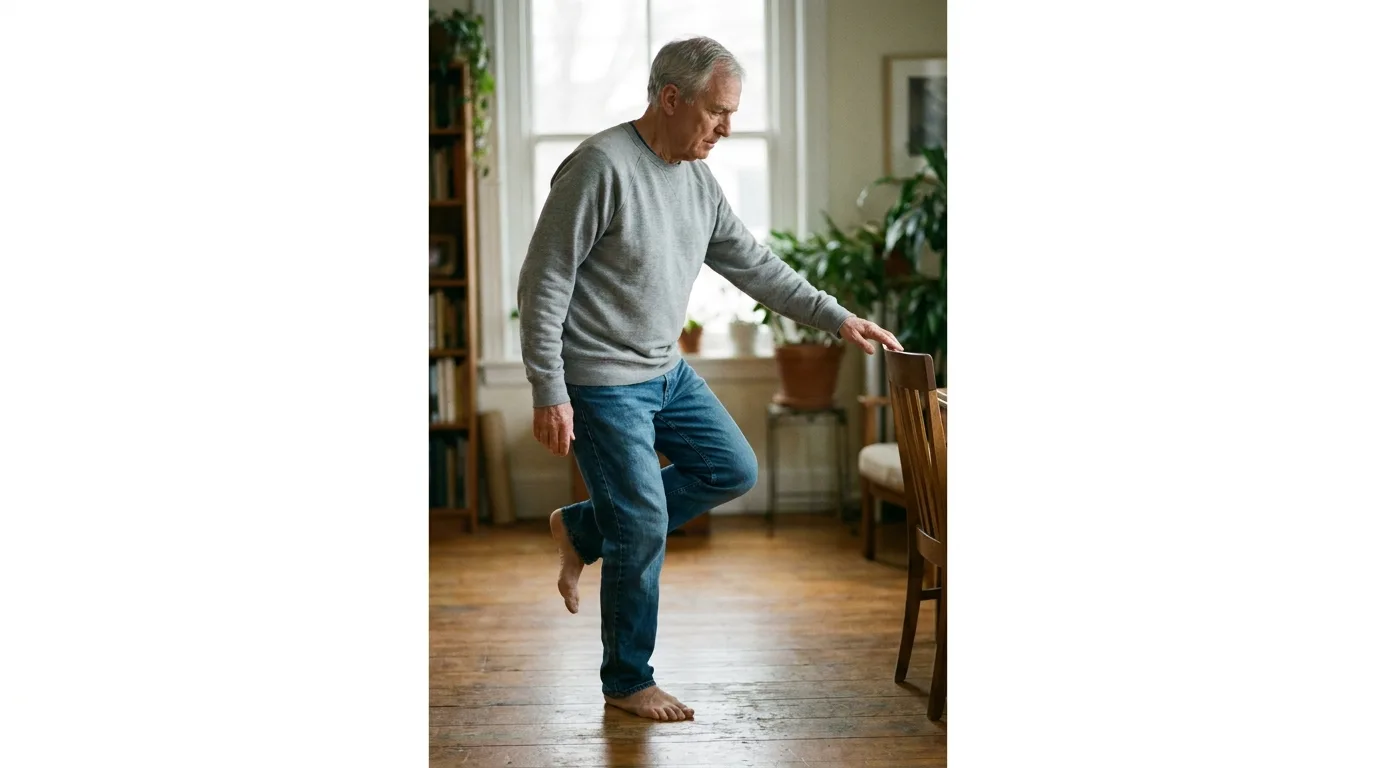
3. The single-leg stand is a simple test you can do at home to gauge your own risk.
The three systems
Staying upright is a team effort between three sources of information.
Vision tells your brain where you are in space. This is why balance feels harder in the dark, or the moment you close your eyes in the shower.
The vestibular system, housed in your inner ear, detects the position and movement of your head. It registers whether you are tilting, turning or speeding up.
Proprioception is the quiet one. Sensors in your muscles, tendons and joints report where your limbs are without you having to look. It is how you walk downstairs without staring at your feet.
All three tend to decline gradually with age. The decline is not fixed, though. Each system adapts when you give it something to work against.
The evidence
A 2019 Cochrane review of 108 trials (23,407 participants) found that exercise programmes which genuinely challenge balance reduce the rate of falls in older adults by 23%. When that balance work is paired with resistance training, the reduction reaches 39% (Sherrington et al., 2019).
That is the part most people miss. Balance is trainable, and the most effective approach combines it with getting stronger. A wobble you can correct is only useful if your legs have the power to act on the correction.
Exercises that target each system
Proprioception. Stand on one leg for 30 seconds. When that feels easy, close your eyes. When that feels easy, stand on a folded towel. Each step removes a source of information and forces the system to work harder.
Vestibular. Turn your head slowly from side to side while walking in a straight line. Or fix your gaze on a point ahead and rotate your head left and right.
Vision. Walk heel-to-toe along a line, looking straight ahead rather than down at your feet.
Strength. The sit-to-stand, rising from a chair without using your hands, builds the leg strength you need to catch yourself after a stumble.
A few minutes most days, done consistently, changes more than the occasional hard session.
How Sway approaches this
Falls prevention is not one thing. It asks for strength to catch yourself, proprioception to detect a stumble early, the confidence to keep moving, and the mobility to recover your footing.
Sway is in-home and online personal training in London, built around one dedicated coach who is qualified in both Pilates and Strength and Conditioning. That matters here, because the same coach who builds your lower-body power also trains your controlled balance and proprioception, in your living room or live over video wherever you are in the world. Nothing is handed between separate people who never speak. Your coach sees the whole picture in one place. And if you already see a physiotherapist or another specialist, your coach coordinates with them rather than working in isolation. Where something falls outside their remit, they can introduce you to a trusted independent specialist from our vetted referral network.
What you can do today
Stand on one leg and time yourself. If you cannot hold it for 20 seconds, that is worth paying attention to.
A 2022 study in the British Journal of Sports Medicine found that an inability to complete a 10-second single-leg stand was associated with nearly double the risk of death from any cause within seven years (Araujo et al., 2022).
It takes ten seconds to try. It tells you something worth knowing. And if the result concerns you, a free assessment, online or in your home in London, is a sensible next step.
References
1. Sherrington C, et al. Exercise for preventing falls in older people living in the community. Cochrane Database of Systematic Reviews. 2019.
2. Araujo CG, et al. Successful 10-second one-legged stance performance predicts survival in middle-aged and older individuals. British Journal of Sports Medicine. 2022.
3. Public Health England. Falls: applying All Our Health. 2022.
Ready to stop guessing?
Book your assessment and meet your coach