← Back to journal
LIFE8 min read2026-04-16
How to find a trainer who understands older bodies
Most personal trainers learn on young, healthy bodies. Few understand osteoarthritis, post-surgical recovery or chronic pain. Here is what to look for and the questions to ask before you commit.

The average personal trainer in the UK is 31 years old. Their qualification taught them to work with healthy adults between 18 and 40, and most of their practical experience is with clients who have no injuries, no chronic conditions and no medications that affect how they respond to exercise.
If you are in your fifties, sixties or beyond, that matters - and it is worth knowing how to find someone who genuinely understands an older body.
Key takeaways
1. Most personal training certifications do not cover age-related conditions such as osteoarthritis, osteoporosis or post-surgical rehabilitation in any depth.
2. A coach who knows your medical history and works with your wider healthcare team produces far better outcomes than one working blind.
3. The right trainer is not the one with the best physique or the most followers. It is the one who understands your conditions, communicates well, and adjusts your programme based on evidence and on how you respond.
The qualification gap
The most common personal training qualifications in the UK cover anatomy, physiology, exercise programming and client communication. They do not cover clinical populations in any depth.
A 2016 study in the Journal of Aging and Physical Activity surveyed personal trainers working with older adults and found that only 28 percent had received any formal training in age-related conditions. The majority reported feeling underqualified to work with clients who had osteoarthritis, osteoporosis or chronic pain (Hawley-Hague et al., 2016).
This does not mean younger trainers cannot be excellent. It means the standard qualification pathway does not, on its own, prepare anyone for the complexities of an older body. The trainers who are genuinely good at this have usually sought out specialist knowledge well beyond their initial certificate - and learned how to modify for a hip replacement or spinal stenosis the hard way, with real clients.
What to look for
There are specific markers that separate a coach equipped for older adults from one who is not.
Relevant additional qualifications. Look beyond the entry-level certificate: a Level 4 qualification in exercise referral or specialist populations, a corrective-exercise or senior-fitness specialism, or a degree in sports science, exercise physiology or physiotherapy all give a stronger clinical foundation.
Experience with people like you. Ask directly: how many clients over 55 do you currently work with, and what conditions have you worked around? Someone who has spent years with people in this stage of life will have met osteoarthritis, joint replacements, chronic back pain, balance issues and post-surgical recovery many times. Experience like that cannot be replaced by a certificate.
An understanding of common medications. Beta-blockers affect heart-rate response to exercise. Blood thinners affect bruising. Corticosteroids affect bone density and tissue healing. A 2018 review in the British Journal of General Practice found that medication-exercise interactions were poorly understood by most exercise professionals surveyed (Din et al., 2018). Your coach need not be a pharmacist, but they should ask about your medications and know when to consult your GP.
Breadth across strength and movement. An older body usually needs both load and control - strength to protect bone and muscle, plus the mobility and balance work that prevents injury. A coach who understands both Pilates-style control and strength training can address the whole picture rather than only half of it.
Questions to ask before you commit
These direct questions will tell you within a few minutes whether a coach is right for your body.
"What proportion of your clients are over 55?" If it is fewer than one in five, they may lack the pattern recognition that comes from working with older bodies daily.
"How do you modify exercises for someone with osteoarthritis?" A good answer is specific: reducing range of motion, avoiding impact loading on affected joints, using isometric holds, progressing cautiously. A vague answer, or one that simply avoids the movement, is a warning sign.
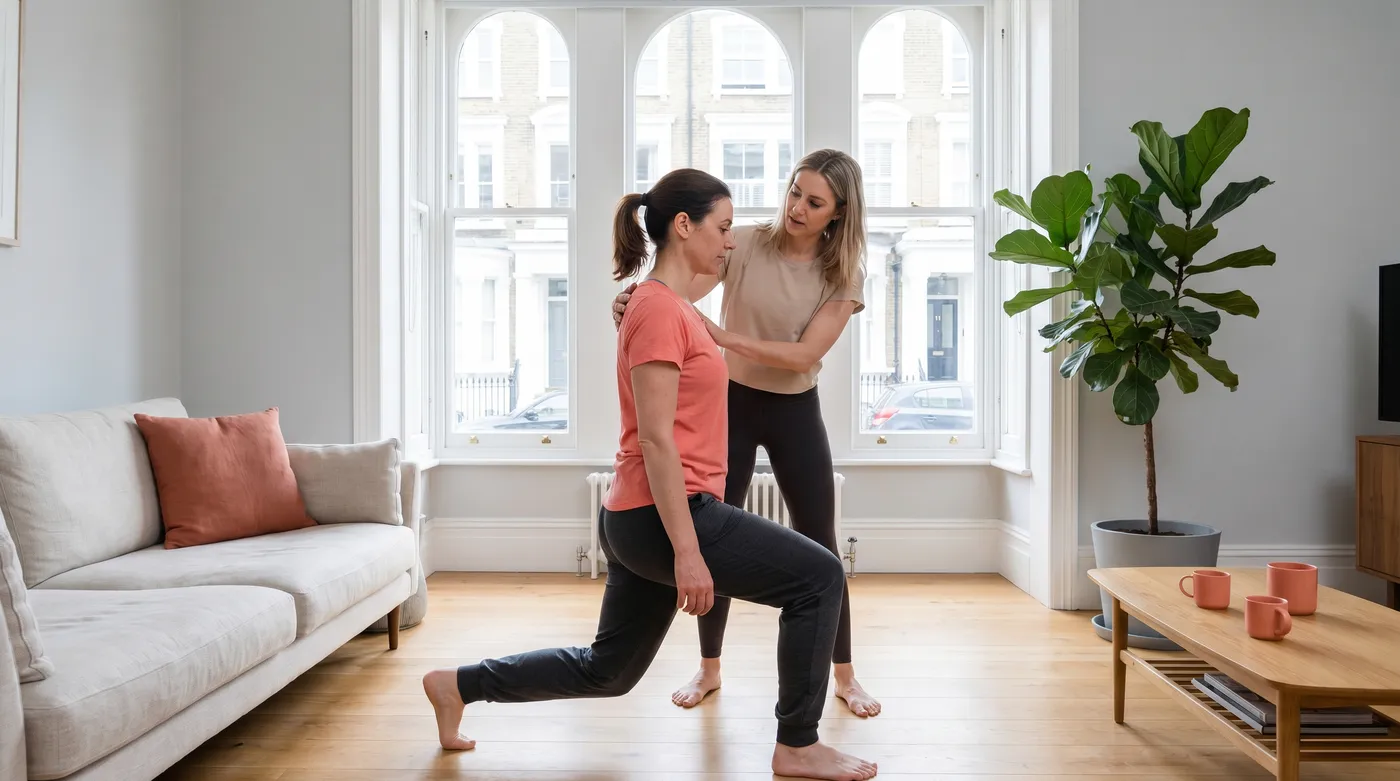
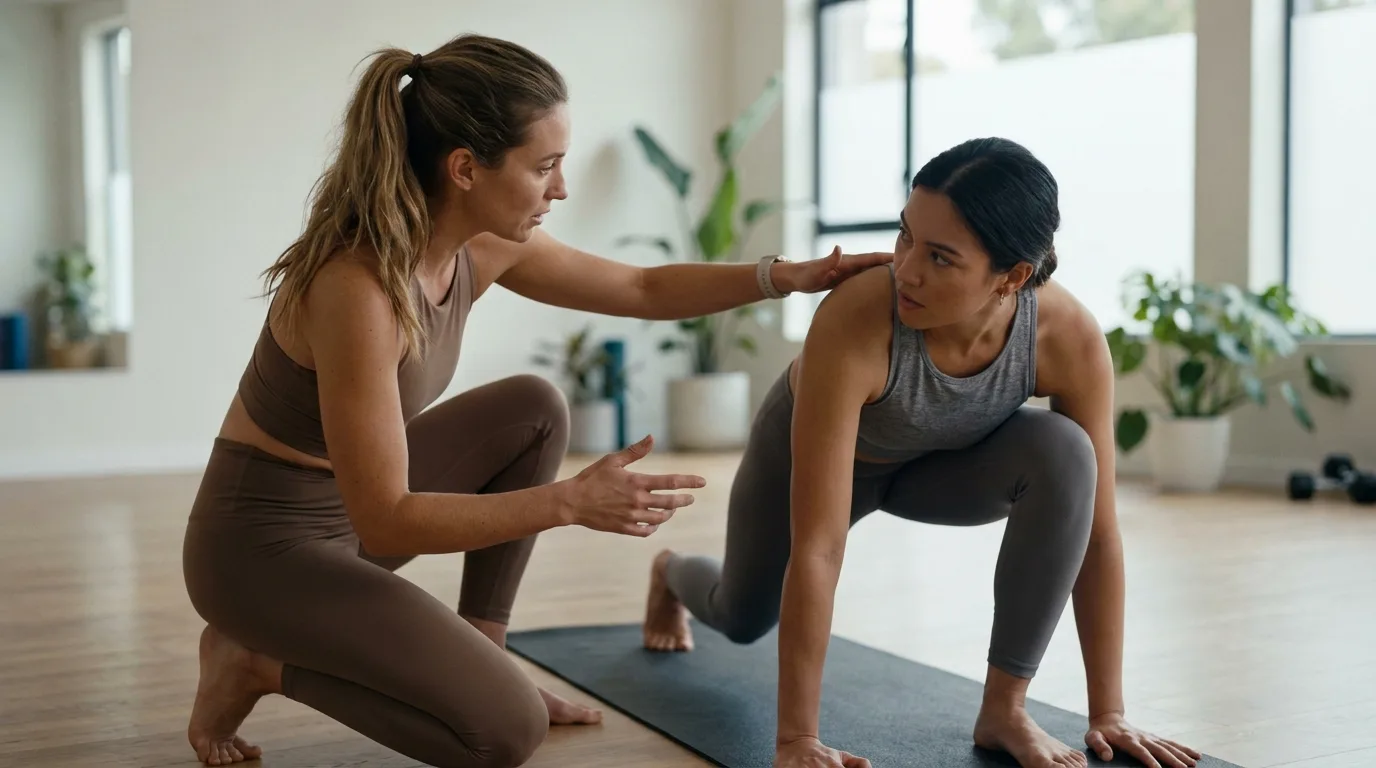
"What does your assessment look like?" A qualified coach assesses how you move before writing anything - range of motion, balance, strength baselines, and questions about pain. A generic programme handed over on day one is a red flag.
"How often will my programme change?" The body adapts to a stimulus within four to eight weeks. A programme that has not changed in three months is no longer producing adaptation. A 2009 Cochrane review confirmed that progressive overload - gradually increasing the challenge - is the mechanism behind strength and function improvements in older adults (Liu and Latham, 2009).
"Will you talk to my physiotherapist or GP if I need it?" A coach who is willing to read a physio's notes and adjust accordingly, or to refer you on when something is outside their scope, is operating at a different level from one who works in isolation.
When you need more than exercise
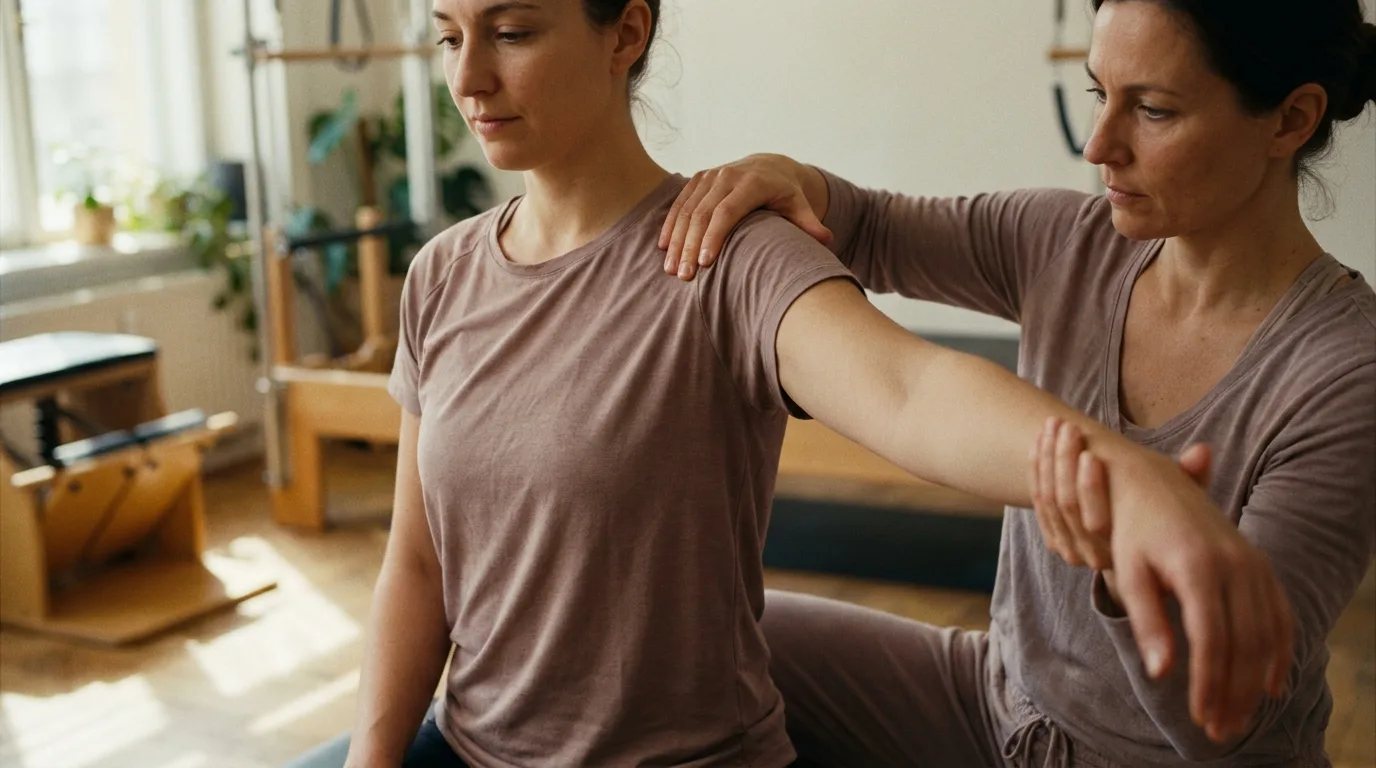
The honest truth is that an older body with any health complexity sometimes needs more than training alone - not because a good coach is insufficient, but because some problems are multi-factorial. A stiff shoulder might involve a rotator cuff issue, a mobility restriction, a stress-driven tension pattern and a training-load problem all at once.
A 2020 systematic review in The Lancet found that best-practice care for musculoskeletal pain involves coordinated physical and, where relevant, psychological input rather than isolated treatment (Lin et al., 2020). The key is having someone who recognises when a problem is beyond exercise and can point you to the right independent professional, rather than pressing on regardless.
How Sway approaches this
Sway is built on a simple idea: one expert coach who genuinely understands older bodies, rather than a generic gym programme.
You work with a single dedicated coach, qualified in both Pilates and Strength and Conditioning, who trains you in your home across London or live online. Because it is the same person every session, they hold your full history - your conditions, your medications, your goals - and adjust your programme as a whole rather than in pieces.
When something needs clinical attention beyond training - a physiotherapy assessment, nutrition support, help with stress or sleep - your coach can introduce you to a trusted, independent specialist from a vetted referral network. These are professionals we trust, not Sway staff, brought in only when they will genuinely help. You are never left to find and coordinate that yourself.
As Sway's head coach explains, with more than 35,000 sessions behind the team since 2018, the work with an older body is to understand exactly what it can do today and build patiently from there.
What you can do today
If you are looking for a coach, write down the questions above and ask them in a first session. The answers will tell you quickly whether this person is equipped for your body.
If you would like to skip the guesswork, we offer a free assessment, in your home in London or online - a careful look at how you move and an honest conversation about what your body needs.
References
1. Hawley-Hague H, et al. Personal trainers' knowledge and attitudes towards working with older adults. Journal of Aging and Physical Activity. 2016.
2. Din NU, et al. Awareness of physical activity guidance and medication-exercise interactions among exercise professionals. British Journal of General Practice. 2018.
3. Liu CJ, Latham NK. Progressive resistance strength training for improving physical function in older adults. Cochrane Database of Systematic Reviews. 2009.
4. Lin I, et al. What does best practice care for musculoskeletal pain look like? The Lancet. 2020.
Ready to stop guessing?
Book your assessment and meet your coach